
If you run a service business and you're still juggling separate phone calls, email threads, and social DMs with no connection between them — this article is for you. In 2026, the way your business communicates isn't just a customer service issue. It's a growth issue.
This guide breaks down the real difference between multichannel and omnichannel strategies, shows you which one drives more revenue, and explains how AI makes the winning approach accessible to any business — not just enterprise brands.
What Is Multichannel Communication?
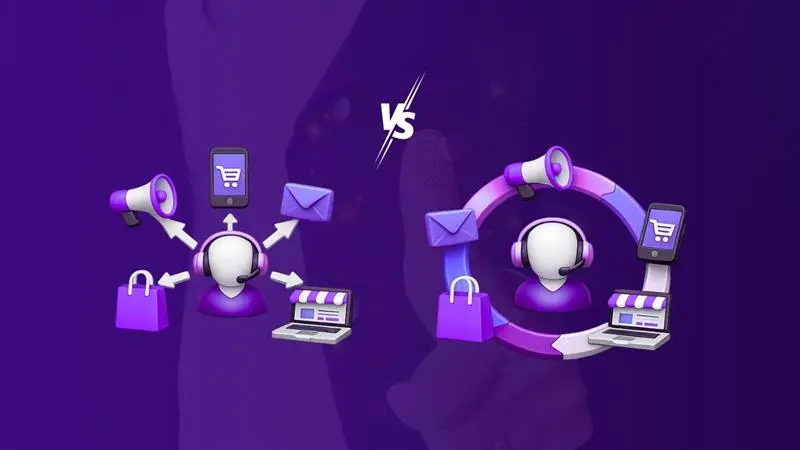
Multichannel simply means your business is active on more than one platform — phone, email, live chat, social media, SMS. Sounds good in theory. The problem is that each channel operates in its own silo.
A customer messages you on Facebook, then calls an hour later. Your team has zero context. The customer has to start from scratch. That's not just frustrating — it kills trust and loses deals.
Where Multichannel Breaks Down
Every conversation resets when a customer switches channels
Leads slip through the gaps between platforms
Response times are unpredictable and often too slow
No unified view of what's actually driving conversions
Teams waste time switching tabs and hunting for context
Multichannel increases your visibility. But visibility without coordination is noise — and it doesn't scale.
What Is Omnichannel Communication?
Omnichannel takes all those platforms and connects them. The focus shifts from the channel to the customer. Instead of managing separate tools, you manage one continuous customer journey — regardless of how or where someone reaches out.
How It Works in Practice
In an omnichannel model, data follows the customer across every touchpoint:
A customer starts a website chat while browsing your services. They get an automated SMS summary. When they call to book, your AI voice agent already knows what they were looking at. The conversation continues, and it never restarts.
Why Omnichannel Outperforms
Faster response times: AI triggers instant, cross-channel replies automatically
Better customer experience: personalized interactions, no repetition required
Higher conversion rates: removing friction makes it easier for customers to say yes
Stronger loyalty: customers return to businesses that make their lives easier
Smarter decisions:one dashboard shows exactly which touchpoints drive revenue
Multichannel vs Omnichannel: Side-by-Side Comparison
Factor | Multichannel | Omnichannel |
Channels | Multiple (siloed) | Multiple (unified) |
Integration | None | Fully connected |
Customer Experience | Fragmented | Seamless |
Response Speed | Inconsistent | Instant / AI-automated |
Conversion Rate | Average | High |
Customer Retention | Weak (~33%) | Strong (~89%) |
Data & Reporting | Scattered | Single dashboard |
Scalability | Limited | Built for growth |
Research consistently supports this finding: companies with strong omnichannel engagement retain an average of 89% of customers, compared to just 33% for businesses operating with disconnected channels.
Which Is Better for Business Growth in 2026?
Short answer: omnichannel wins — and it's not close.
Multichannel gets you in the room. Omnichannel closes the deal, keeps the customer, and builds compounding revenue. Here's why:
1. More Leads Actually Convert
Friction is the enemy of sales. Every time a customer has to re-explain themselves or wait for a manual response, you lose momentum. Omnichannel removes that friction entirely — a lead that starts on chat can book an appointment in the same flow, automatically.
2. Speed Wins the Job
In 2026, the first business to respond wins. AI-powered omnichannel platforms send instant replies across any channel 24/7 — so no lead goes cold while you're in the field.
3. Customers Stay Longer
Loyalty is built on convenience. When a business remembers a customer's preferences across SMS, chat, and phone — it creates a concierge-level experience that multichannel simply can't replicate.
4. Your Team Works Smarter
With unified communication, your team stops tab-switching and starts closing. Less time hunting for context, more time delivering results.
5. You Know What's Actually Working
Guessing which channel drives revenue is expensive. Omnichannel gives you a single source of truth for marketing spend, conversion data, and customer behaviour.
Real Business Example: Local Service Company
The Old Way — Multichannel (Siloed)
Calls go to voicemail after hours and are rarely returned
Website chat sends an email the owner checks once a day
No automated reminders — 20% no-show rate
Result: high stress, missed revenue, frustrated customers
The Better Way — Omnichannel with Chatley AI
AI receptionist answers every call 24/7 and books directly into the calendar
Instant SMS confirmation sent automatically after every call
Website chat captures leads and syncs them to the customer's phone record
Owner sees every interaction — voice, text, chat — in one unified dashboard
Result: 40% increase in booked jobs, zero missed opportunities, professional brand image
When Does Multichannel Still Make Sense?
Multichannel can be a reasonable starting point if you are:
A solo operator just testing your first communication channels
Handling fewer than 2–3 leads per week
Operating on a strict zero-budget with no room for growth tools
It's a starting point — not a long-term strategy. Most businesses hit its ceiling faster than they expect.
When to Move to Omnichannel
Transition now if any of these apply to your business:
You're growing quickly and manual processes are breaking
Leads are falling through the cracks between platforms
You manage multiple locations and need consistent experiences
High call volume is overwhelming your team
You want to maximize the return on every marketing dollar
How AI Makes Omnichannel Accessible to Any Business
A few years ago, omnichannel required enterprise IT budgets. AI has changed everything. Modern platforms bring this capability to SMBs at a fraction of the cost — with no dev team required.
What AI-Powered Omnichannel Looks Like Today
AI Voice Agents: answer calls, provide context-aware support, book appointments
Two-Way SMS Automation: nurture leads with intelligent follow-up sequences
AI Web Chat: real-time lead capture beyond basic contact forms
Shared Knowledge Base: AI knows your business facts across every channel
Appointment Scheduling: conversations connect directly to calendar and revenue
How Chatley AI Delivers the Omnichannel Advantage
Chatley AI is purpose-built to connect your channels — not just add more of them. Instead of paying for five tools that don't talk to each other, you get one connected platform designed for modern business growth.
What's Included
AI Voice Agents: never miss a call or a booking opportunity
SMS Automation: keep conversations going where customers prefer
AI Web Chat: turn visitors into qualified leads instantly
Unified Customer Profiles: every interaction stored in one place
Calendar Integration: seamlessly turn conversations into appointments
Growth Dashboards: see exactly which channels are growing your revenue
Conclusion
If your channels don't talk to each other, you're working harder than you need to — and you're leaving revenue on the table.
In 2026, the businesses that grow fastest aren't just the ones that are everywhere. They're the ones that make being everywhere feel like one effortless conversation for the customer.
Omnichannel isn't the future. It's the current standard — and AI has made it affordable for every business.
Stop losing leads across calls, SMS, and chat.
Explore how Chatley AI helps businesses grow with an omnichannel AI CX platform.